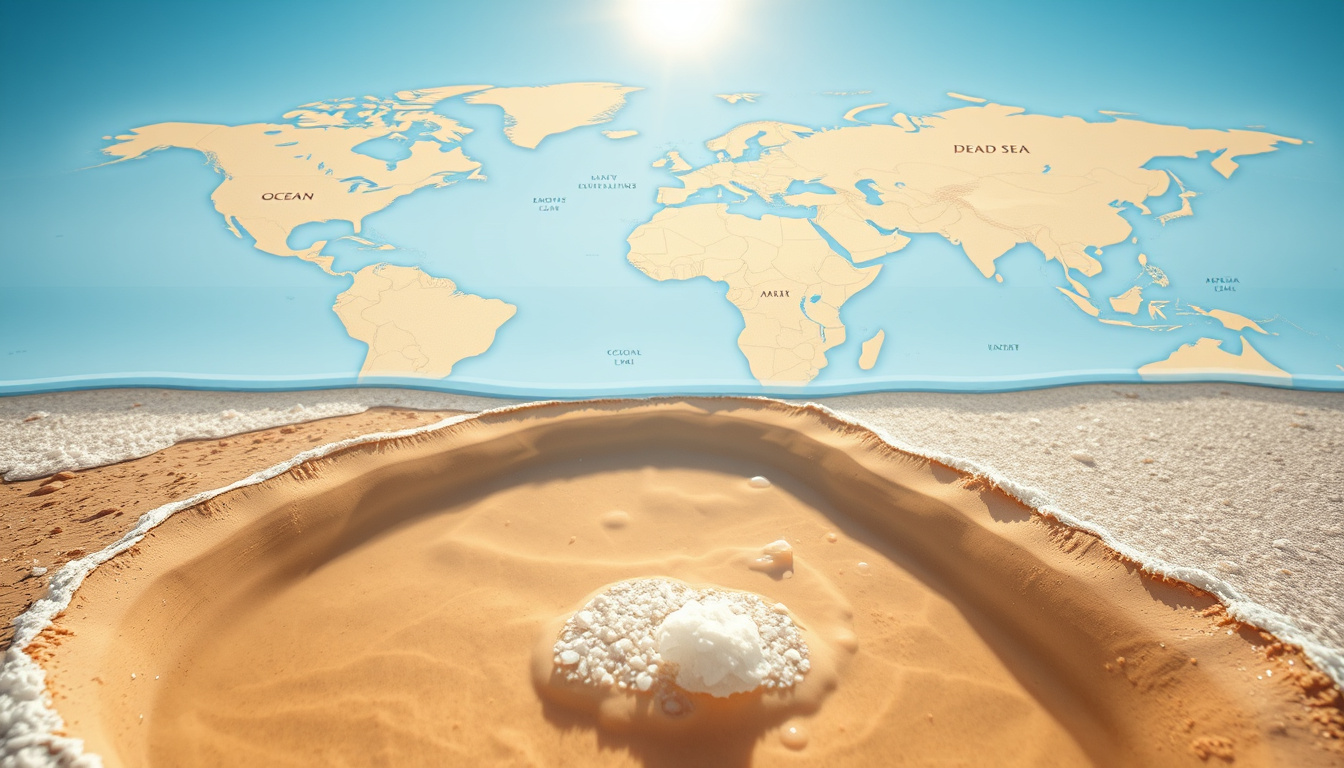
Ever wonder why a sip of ocean water is so much saltier than a dip in a lake? The answer lies in sea salinity — average ocean salinity sits at about 35 parts per thousand (3.5%), according to the U.S. Geological Survey (USGS, federal water science agency), and the saltiest seas on Earth hold clues to our changing climate.
Average ocean salinity: 35 parts per thousand (3.5%) ·
Dead Sea salinity: approximately 34% (342 ppt) ·
Red Sea salinity: about 40 ppt ·
Freshwater salinity threshold: <0.5 ppt ·
Ocean surface area: covers 70% of Earth
Quick snapshot
- Average ocean salinity is ~35 ppt (USGS)
- Dead Sea is the saltiest large water body on Earth (Britannica)
- Salinity drives ocean density and circulation (NASA Salinity)
- Exact contribution of hydrothermal vents to long-term ocean salinity (NOAA Ocean Exploration)
- Future salinity trends under climate change (freshening in some regions, salinification in others) (Science China Earth Sciences)
- Precise mechanisms of deep-sea salinity variations (Journal of Climate)
- 2011–2021: NASA’s Aquarius and SMAP satellites record global sea surface salinity (NASA Salinity)
- 1900s: CTD profilers become standard for salinity measurement (NOAA)
- Pre-1800s: Early sailors note saltiness variations; first measurements via evaporation (USGS)
The table below captures baseline salinity figures across different water body types — from open ocean to landlocked lakes.
| Label | Value |
|---|---|
| Average salinity | 35 ppt (3.5%) |
| Highest ocean salinity | Atlantic Ocean (~37 ppt) |
| Highest lake salinity | Dead Sea (~342 ppt) |
| Lowest ocean salinity | Arctic Ocean (~28 ppt) |
| Unit | Parts per thousand (ppt) or PSU |
| Freshwater threshold | < 0.5 ppt |
What is the salinity of sea water?
How is salinity measured?
- Salinity is the concentration of dissolved salts in water, typically measured in parts per thousand (ppt) (USGS, federal water science agency).
- Modern instruments use conductivity sensors; historical methods involved evaporation (NOAA, national oceanic and atmospheric administration).
- Satellites like NASA’s Aquarius and SMAP measure sea surface salinity from space (NASA Salinity space agency earth science division).
What is the average salinity of seawater?
- Average ocean salinity is about 35 ppt (3.5%) (USGS, federal water science agency).
- Salinity varies by location due to evaporation, precipitation, and freshwater inflow (NOAA, national oceanic and atmospheric administration).
The pattern: Salinity is not uniform — it’s a dynamic property that changes with latitude, season, and climate.
Why is sea water salty?
What processes add salt to the ocean?
- Rivers carry dissolved salts from rocks and soil to the ocean (USGS, federal water science agency).
- Hydrothermal vents and volcanic activity release minerals (NOAA, national oceanic and atmospheric administration).
- Evaporation concentrates salts, while precipitation dilutes (NOAA, national oceanic and atmospheric administration).
Do undersea vents contribute to salinity?
- Hydrothermal vents release dissolved minerals, but their exact contribution to long-term salinity is still unclear (NOAA Ocean Exploration).
The ocean’s saltiness is a balance of inputs (rivers, vents) and outputs (evaporation, precipitation). Climate change tips that balance — and salinity records the shift.
The implication: Tracking salinity inputs and outputs gives scientists a direct window into how the global water cycle is responding to a warming planet.
What sea has the highest salinity in the world?
Which ocean has the highest salinity?
- Among the five oceans, the Atlantic Ocean has the highest average surface salinity, around 37 ppt (NOAA, national oceanic and atmospheric administration).
- The Red Sea, a marginal sea, reaches about 40 ppt due to high evaporation and limited freshwater inflow (Britannica).
How does the Dead Sea compare?
- The Dead Sea has the highest salinity of any large water body, around 34% (342 ppt) — roughly 10 times saltier than the ocean (Britannica).
- Its extreme salinity prevents most aquatic life (Britannica).
One comparison, one pattern: the Dead Sea is more than eight times saltier than the Red Sea, and the Red Sea is saltier than the open ocean.
| Water body | Salinity (ppt) | Type |
|---|---|---|
| Dead Sea | ~342 | Landlocked lake |
| Red Sea | ~40 | Marginal sea |
| Atlantic Ocean | ~37 | Ocean |
| Pacific Ocean | ~34 | Ocean |
| Arctic Ocean | ~28 | Ocean |
| Great Salt Lake | ~150–270 | Lake |
The implication: The saltiest waters are found in enclosed basins with high evaporation — and those same basins are bellwethers for regional climate change.
Are salt and salinity the same?
What is the difference between salt and salinity?
- Salt refers to a specific chemical compound (NaCl), while salinity refers to the total dissolved salt concentration (USGS, federal water science agency).
- Salinity includes all dissolved ions, not just sodium chloride (NOAA, national oceanic and atmospheric administration).
How is salinity measured differently from salt content?
- Salinity is measured in ppt or practical salinity units (PSU); salt content is usually expressed as a percentage or mass fraction (NOAA, national oceanic and atmospheric administration).
Confusing “salt” with “salinity” leads to misunderstanding how ocean chemistry works. Salinity is the full ionic fingerprint, and it’s what drives density and circulation.
The pattern: Precision in language reflects precision in science — salinity is not just about taste, it’s the metric that governs ocean physics.
Which is saltier, Red Sea or Dead Sea?
What is the exact salinity of the Dead Sea?
- The Dead Sea has a salinity of approximately 342 ppt (Britannica).
What is the salinity of the Red Sea?
- The Red Sea has a salinity near 40 ppt (Britannica).
The Dead Sea is saltier by a factor of about 8.5. The high salinity of the Dead Sea prevents most aquatic life.
The trade-off: Salinity extremes create unique ecosystems (or none at all) and serve as natural laboratories for studying the limits of life.
Timeline of sea salinity understanding
- : Early sailors note saltiness variations; first salinity measurements using evaporation (USGS, federal water science agency).
- : Systematic salinity measurement using conductivity-temperature-depth (CTD) profilers becomes standard (NOAA, national oceanic and atmospheric administration).
- : NASA’s Aquarius and SMAP satellites record global sea surface salinity, revealing annual and seasonal patterns (NASA Salinity space agency earth science division).
Confirmed facts and open questions
Confirmed facts
- Average ocean salinity is ~35 ppt (USGS, federal water science agency).
- Dead Sea is the saltiest large water body on Earth (Britannica).
- Salinity is a key driver of ocean density and circulation (NASA Salinity space agency earth science division).
What’s unclear
- Exact contribution of hydrothermal vents to long-term ocean salinity (NOAA Ocean Exploration).
- Future salinity trends under climate change (freshening in some regions, salinification in others) (Science China Earth Sciences).
- Precise mechanisms of deep-sea salinity variations (Journal of Climate).
Expert perspectives on sea salinity
The concentration of salt in seawater (its salinity) is about 35 parts per thousand.
— USGS (federal water science agency)
Sea surface salinity is a key tracer for the global water cycle and ocean circulation.
Salinity influences the freezing point of seawater and is critical for marine life habitats.
For policymakers, the message is clear: monitoring sea salinity trends is essential for anticipating shifts in ocean circulation that affect global climate patterns. The IPCC (Intergovernmental Panel on Climate Change) reports high confidence that regional salinity changes are driven by ocean circulation changes superimposed on longer-term trends. Without sustained satellite observations and ocean buoy networks, we risk missing the signals that connect the water cycle to climate change.
pmc.ncbi.nlm.nih.gov, os.copernicus.org, mynasadata.larc.nasa.gov, aoml.noaa.gov, mit.whoi.edu, phys.org, archive.ipcc.ch, pnas.org
Related coverage: detailed guide on sea salinity fördjupar bilden av Sea Salinity Explained: Highest & Lowest Seas, FAQs.
Frequently asked questions
How is salinity measured in the ocean?
Salinity is measured using conductivity sensors on CTD profilers, by analyzing water samples, and via satellite remote sensing (NOAA, national oceanic and atmospheric administration).
What units are used for salinity?
Salinity is expressed in parts per thousand (ppt) or practical salinity units (PSU), which are numerically equivalent (USGS, federal water science agency).
Does salinity affect ocean currents?
Yes — salinity, along with temperature, determines seawater density, which drives thermohaline circulation (NASA Salinity space agency earth science division).
Can salinity change over time?
Yes, salinity changes due to evaporation, precipitation, river inflow, ice melt, and climate shifts (Science China Earth Sciences).
What is the salinity of the Great Salt Lake?
The Great Salt Lake’s salinity ranges from about 150 to 270 ppt, varying with lake level and location (USGS Utah Water Science Center).
How does salinity affect marine life?
Marine organisms have adapted to specific salinity ranges; extreme salinities like the Dead Sea prevent most life (NOAA, national oceanic and atmospheric administration).
What is the salinity of freshwater?
Freshwater has salinity below 0.5 ppt (USGS, federal water science agency).
Why does the Dead Sea have such high salinity?
The Dead Sea is a terminal lake with no outlet, high evaporation, and mineral-rich inflow from the Jordan River (Britannica).
Related stories





Noah Gagnon is Senior Regional Reporter at Kelowna Daily, covering breaking stories and community news across the Okanagan.