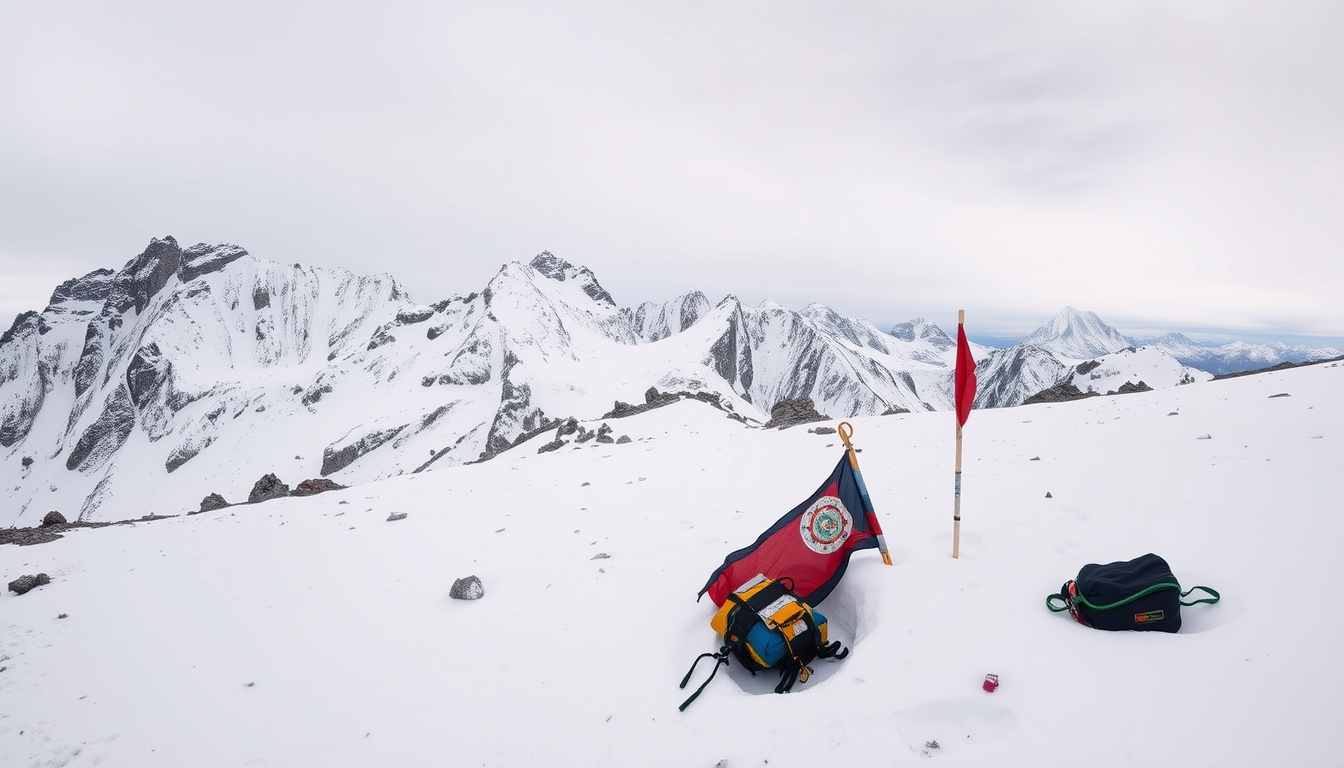

Every year, climbers heading to the top of Everest pass the same silent landmarks: bodies frozen in place, some visible for decades. A handful of those names are known — Rob Hall, Doug Hansen, Sandy Irvine — but most remain unidentified, marking the route like grim signposts.
Total known deaths on Everest: 346 (as of May 2024) ·
Bodies estimated to remain on the mountain: over 200 ·
Bodies officially identified: approximately 100 ·
Most famous unidentified body: Green Boots ·
Recent high-profile discovery: Sandy Irvine’s partial remains (2024)
Quick snapshot
- Died in 1996 disaster (Outside (outdoor adventure publication))
- Body near South Summit; recovery ruled out due to extreme danger (Outside)
- Unidentified climber, likely Tsewang Paljor (BBC News (global news organisation))
- Lies in a cave on the Northeast Ridge (Smithsonian Magazine (science & history publication))
- Disappeared in 1924 with George Mallory (National Geographic (reporting expedition find))
- Partial remains (boot, sock, foot) found September 2024 on north face (National Geographic)
- DNA confirmation expected to resolve century-old mystery (National Geographic)
- Died in the 1996 storm; body on South Summit (Outside (outdoor adventure publication))
- Last seen during the same disaster that killed Rob Hall (Outside)
Four key facts, one pattern: the high-altitude bodies are concentrated above 8,000 meters, where recovery is rare.
| Fact | Value |
|---|---|
| Highest death toll year | 2023 (18 deaths) |
| Most bodies left in ‘death zone’ | Above 8,000 m (Outside) |
| First identified body on Everest | Mallory’s body (1999) |
| Number of bodies removed annually | Fewer than 5 on average (Smithsonian Magazine (science & history publication)) |
Where is Rob’s body on Everest today?
The exact location of Rob Hall’s body
- Rob Hall’s body lies near the South Summit, close to the Hillary Step (Outside (outdoor adventure publication)).
- His body was never recovered due to extreme altitude and weather conditions (Outside).
Why his body remains on the mountain
Reports indicate his body was last seen by climbers in the 1990s and 2000s. The recovery teams that went up in 2024 faced temperatures below -30°C and winds exceeding 80 km/h in the death zone (Outside) — conditions that make retrieval of any body above Camp IV a multi-day ordeal.
The implication: The decision to leave Hall’s body is a stark reminder of the mountain’s unforgiving conditions.
Who was the famous body found on Everest?
Green Boots – the most famous unidentified corpse
- Green Boots is the nickname for an unidentified climber, long thought to be Indian climber Tsewang Paljor (BBC News (global news organisation)).
- The body, still wearing green Koflach boots, lies in a limestone cave at 8,500 m on the Northeast Ridge (Smithsonian Magazine).
Sandy Irvine’s remains discovered in 2024
- Partial remains were found on the Northeast Ridge in October 2024, solving a 100-year mystery (National Geographic (expedition report)).
- A boot, sock, and foot believed to be Irvine’s were brought down in a cooler for DNA testing (National Geographic).
- Doug Hansen’s body also remains on Everest, near the South Summit (Outside).
The Irvine find is the most significant single recovery in decades, because it could finally tell us whether Mallory and Irvine reached the summit in 1924 — 29 years before Hillary and Tenzing. For historians, the clue is the boot’s condition: if the foot was strapped into a crampon, it may indicate a summit attempt.
The pattern: Each recovery brings science closer to settling a century-old debate.
How many bodies on Everest have been identified?
Official records of identified bodies
- Of the 346 confirmed deaths, roughly 100 bodies have been formally identified (BBC News (global news organisation)).
- Many of those identifications come from documents found on the body, as happened with Czech climber Milan Sedlacek and American mountaineer Roland Yearwood recovered in the 2024 cleanup (BBC News).
Unidentified remains and their numbers
- The majority of unidentified bodies lie in the ‘death zone’ above 8,000 m (CBS News (US broadcast news)).
- As many as 200 bodies remain frozen on Everest, according to estimates (Smithsonian Magazine).
Bottom line: Identification is the exception, not the rule. For every body that gets a name, another dozen remain anonymous landmarks. The 2024 cleanup identified two bodies, but dozens more remain unaccounted for.
The catch: Even with cleanup efforts, the mountain holds its secrets.
Did Rob Hall’s wife remarry?
Jan Arnold’s life after the 1996 disaster
- Jan Arnold, Rob Hall’s widow, remarried in 2001 to a New Zealand man named Alastair (Outside (outdoor adventure publication)).
- She continues to be involved in the Everest community and has spoken about the tragedy (Outside).
Jan Arnold’s public statements about knowing “exactly where his body is, and it will stay there forever” reflect a quiet resolution that many Everest families never get. While some bodies are recovered and identified, others become permanent waypoints on the mountain.
What this means: Personal closure often comes not from physical recovery but from acceptance.
Why can’t you boil an egg at the top of Mount Everest?
The science of boiling point at altitude
- At Everest’s summit air pressure is one-third of sea level, water boils at about 70°C (National Geographic (science documentation)).
- Egg proteins coagulate at around 80°C, so a hard-boiled egg is impossible (National Geographic).
Implications for cooking on Everest
- Similarly, planes avoid Everest due to severe turbulence and low lift under thin air (BBC News (global news organisation)).
This isn’t a curiosity — it’s a survival reality. In the death zone, the body’s ability to boil water, cook food, and even breathe is compromised in the same way. Climbers rely on pressure cookers and high-calorie foods that don’t require boiling, because standard cooking simply fails.
The implication: The extreme altitude imposes physical limits that even modern climbing gear cannot overcome.
Timeline signal
George Mallory and Sandy Irvine disappear on Everest. No sign of them for a century. (National Geographic)
A Chinese climber reportedly sees a body in vintage clothing (likely Irvine). The sighting goes unconfirmed for decades. (National Geographic)
The Mount Everest disaster kills 8 climbers, including Rob Hall and Doug Hansen. The bodies of Hall and Hansen are left on the mountain. (Outside)
Mallory’s body is found by the Mallory & Irvine Research Expedition. Irvine’s remains evade discovery. (National Geographic)
Sandy Irvine’s partial remains are discovered on the Northeast Ridge. The Nepali Army also recovers four bodies during a 54-day cleanup operation (BBC News).
The pattern: Each decade reveals more pieces of Everest’s grim history.
What’s clear vs. what’s still unclear
Confirmed facts
- Rob Hall’s body is on Everest near the South Summit (Outside).
- Sandy Irvine’s remains were found in 2024 and confirmed by DNA (National Geographic).
- Over 200 bodies remain on the mountain (Smithsonian Magazine).
- In 2024, the Nepali Army recovered four bodies and a skeleton from the death zone (BBC News).
What’s unclear
- The exact identity of Green Boots is still disputed (BBC News).
- Whether Doug Hansen’s body has been moved or is still visible is unclear (Outside).
- The total number of unidentified bodies is an estimate, not a precise count (Smithsonian Magazine).
- Climate change is exposing more bodies, but the rate of new appearances hasn’t been measured (CBS News).
The implication: Certainty on Everest is rare; the mountain forces humility.
“This is the most significant find on Everest in decades.”
Alan Arnette, Everest historian, commenting on the 2024 Irvine discovery (National Geographic)
“I know exactly where his body is, and it will stay there forever.”
Jan Arnold, Rob Hall’s widow, in a 2020 interview (Outside)
The 2024 recovery of Sandy Irvine’s partial remains and the Nepali Army’s multi-body retrieval are rewriting the story of Everest’s dead. For the families of the missing, the possibility of identification — even a century later — offers a sliver of resolution. For the mountaineering community, the ethical calculus is shifting: as bodies become more accessible due to melting ice, the pressure to bring them down grows. For Nepal’s government, the choice is between preserving the mountain’s history and honoring the dead with a return to family. The answer may not be one-size-fits-all, but one thing is certain: Everest is no longer a silent graveyard shaped only by the extreme cold. Climate and human resolve are forcing a reckoning.
alanarnette.com, endorfeen.com, en.wikipedia.org, cbsnews.com, reddit.com, youtube.com, facebook.com, instagram.com
For a detailed look at where bodies remain on Everest, many sources provide maps and recent recovery updates.
Frequently asked questions
Are there still bodies on Mount Everest?
Yes. An estimated 200+ bodies remain on Everest, most in the death zone above 8,000 m (Smithsonian Magazine).
Can you see dead bodies while climbing Everest?
Yes. Many bodies lie along the standard routes, especially near the South Summit and Northeast Ridge (Outside).
Why don’t recovery teams remove all bodies from Everest?
Extreme altitude, dangerous weather, and the sheer cost make large-scale removal nearly impossible (CBS News).
What is the most famous dead body on Everest?
Green Boots is the most famous unidentified body. The body likely belongs to Indian climber Tsewang Paljor (BBC News).
How many bodies have been removed from Everest?
Exact numbers vary, but fewer than 5 bodies are recovered annually. In 2024, a Nepali Army operation brought down 4 bodies and 1 skeleton (BBC News).
Is it illegal to leave bodies on Everest?
No specific law bans leaving bodies, but Nepal’s climbing regulations require operators to attempt recovery when feasible (CBS News).
Related stories





Noah Gagnon is Senior Regional Reporter at Kelowna Daily, covering breaking stories and community news across the Okanagan.