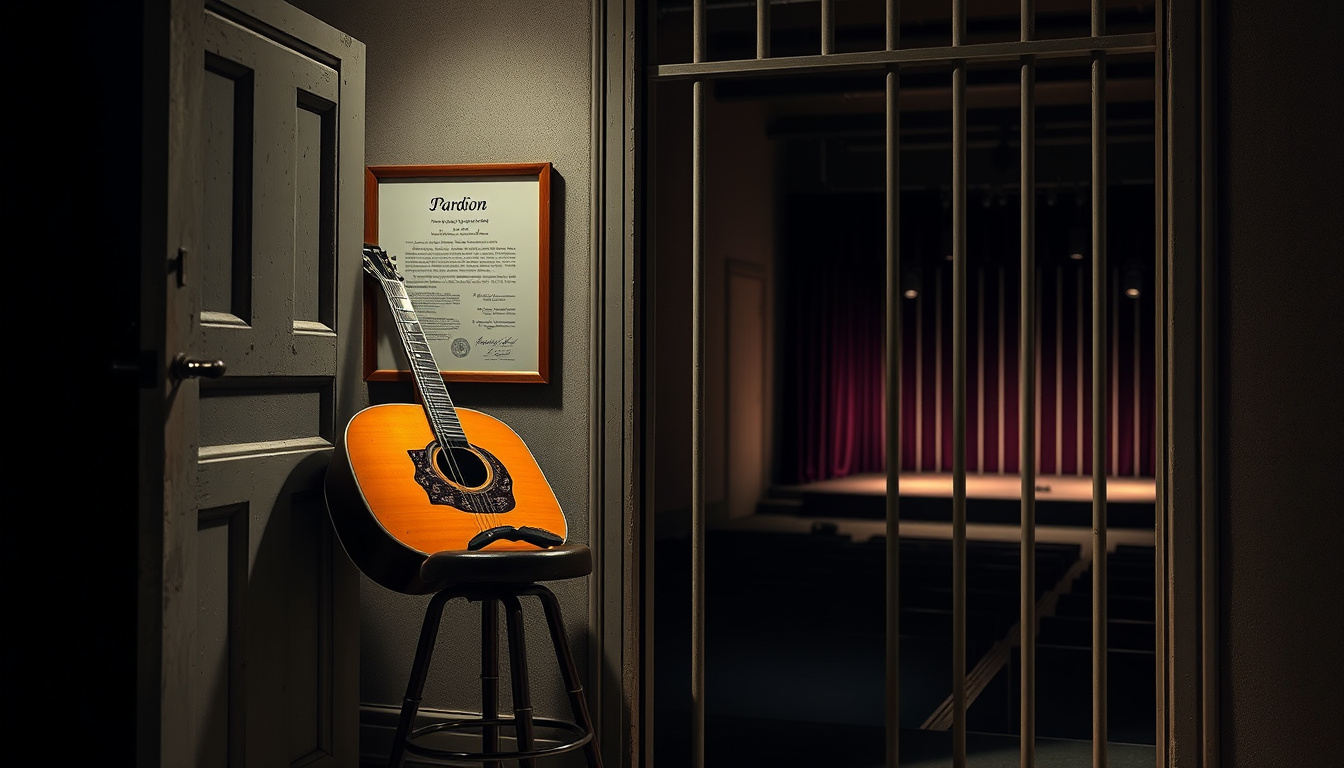
Merle Haggard was a singer who lived his songs—a juvenile delinquent turned San Quentin inmate turned country music legend. Before he ever stepped onto a stage, he was handed a second chance by Governor Ronald Reagan, and by the time he died on his 79th birthday, he had become the working man’s poet and the conscience of a generation.
Born: April 6, 1937, Bakersfield, California, U.S. · Died: April 6, 2016 (age 79), Palo Cedro, California, U.S. · Genres: Country, outlaw country, honky-tonk · Number one hits: 38 on Billboard country charts · Inducted into: Country Music Hall of Fame (2007)
Quick snapshot
- Pardoned by Governor Ronald Reagan in 1972 (The New York Times)
- Inducted into the Country Music Hall of Fame in 2007 (Country Music Hall of Fame)
- Earned 38 number-one Billboard country hits (Biography.com)
- Died from complications of pneumonia on his 79th birthday (PBS Ken Burns Country Music documentary)
- Exact nature of any romantic feelings for Dolly Parton
- Precise wording of his final moments (varied accounts)
- Full depth of the feud with Waylon Jennings
- 1937: Born in Oildale, California (PBS)
- 1950s: Incarcerated at San Quentin (PBS)
- 1972: Granted full pardon by Gov. Ronald Reagan (The New York Times)
- 2016: Dies on April 6, his 79th birthday (PBS)
- Continued reassessment of his political legacy
- Reissues and box sets keeping his catalog alive
- Influence on contemporary country and Americana artists
A dozen facts, one through line: Haggard’s life was a series of second acts — from convict to chart-topper, from outlaw to elder statesman.
| Label | Value |
|---|---|
| Full Name | Merle Ronald Haggard |
| Born | April 6, 1937, Bakersfield, California |
| Died | April 6, 2016, Palo Cedro, California |
| Genres | Country, Outlaw Country, Honky-Tonk |
| Occupation | Singer, songwriter, guitarist, fiddler |
| Years Active | 1960–2016 |
| Spouses | 5 (including Leona Williams, Theresa Lane) |
| Children | 6 |
| Number One Hits | 38 (Billboard Country charts) |
| Signature Songs | Okie from Muskogee, Mama Tried, The Fightin’ Side of Me |
| Nickname | The Poet of the Common Man |
| Award | Country Music Hall of Fame (2007) |
What Was Merle Haggard Pardoned For?
When Merle Haggard walked into San Quentin at age 20, he was just another inmate number. When he walked out, he was a man with a guitar and a mission. The path to his 1972 pardon began in the oil fields of California and the juvenile detention centers he repeatedly escaped.
Haggard’s criminal record could have defined him. Instead, his rehabilitation redefined his future — and country music.
What crimes did Merle Haggard commit?
- Repeatedly arrested for truancy and other petty offenses as a youth (PBS Ken Burns Country Music documentary).
- Escaped juvenile detention centers multiple times.
- His crimes culminated in a botched burglary and attempted escape, landing him in San Quentin (Saving Country Music, the commentary site).
The pattern was clear: a frustrated, fatherless kid acting out. Haggard’s father died when he was nine, and his family — Okie migrants from Oklahoma — struggled in the Dust Bowl diaspora (PBS).
Inside San Quentin, Haggard watched Johnny Cash perform. The experience planted a seed. By the time he was paroled in 1960, he had a new identity: working musician.
How did Merle Haggard turn his life around?
- Paroled in 1960 and immediately pursued a music career.
- By 1965 he was topping the country charts with real-life prison songs.
- He received a full pardon from Ronald Reagan in 1972 (The New York Times).
The turnaround was swift. His songs about convicts, fugitives, and regret — “Branded Man,” “Sing Me Back Home,” “Mama Tried” — resonated precisely because they were true (Saving Country Music).
On March 21, 1972, California Governor Ronald Reagan signed a “full and unconditional pardon” (The New York Times). Some sources, like American Songwriter, the music industry publication, list the date as March 14. Regardless of the exact day, the pardon was a formal recognition of a transformation that Haggard had already written into the cultural record.
The implication: The pardon was not an erasure — it was an acknowledgment that his music had made his biography a bridge between the justice system and American culture.
What Was Merle Haggard’s Signature Song?
Haggard didn’t have one signature song — he had three, each cutting a different facet of the American working class. “Mama Tried” is a prisoner’s lament. “The Fightin’ Side of Me” is a patriot’s warning. And “Okie from Muskogee” is a cultural Rorschach test that still divides listeners.
What is Merle Haggard’s most famous song?
- “Mama Tried” reached number one on the country charts in 1968 and became Haggard’s first defining hit (PBS Ken Burns Country Music documentary).
- “Okie from Muskogee” (1969) was written as a humorous take on small-town values but was adopted as an anthem for the conservative Silent Majority.
- “The Fightin’ Side of Me” (1970) doubled down on the patriotic stance, a direct rebuttal to anti-war protesters.
Most critics and fans point to “Mama Tried” as his masterpiece — a tightly wound three-minute story of a son who broke his mother’s heart by choosing crime. But commercially, “Okie from Muskogee” was the song that made him a household name (Biography.com).
Why is ‘Okie from Muskogee’ controversial?
Written partly as a joke, the song was taken as a serious political manifesto. Haggard himself later admitted it was ‘ignorant’ and assumed things about places he had never been (Wikipedia).
The controversy around “Okie from Muskogee” has never died. Written partly as a joke between Haggard and his band, the song mocks marijuana smokers, flag burners, and draft dodgers. It was embraced by conservatives and despised by the counterculture. Years later, Haggard admitted the song was “ignorant” and that it assumed things about places he had never been. Yet he never disowned it. It remains his most-streamed song, a complicated artifact of a divided era.
Was Merle Haggard in Love with Dolly Parton?
One of the most persistent rumors in country music gossip is that Haggard was secretly in love with Dolly Parton. The two shared a famous duet (“The Day I Fall in Love”) and obvious chemistry on stage. But Parton herself has always debunked the idea.
Parton stated publicly: “We were just friends, but he was a great man” (PBS Ken Burns Country Music documentary). Professional chemistry is not romantic proof.
Who was Merle Haggard married to?
- Leona Williams (1978–1984)
- Theresa Lane (1993–2016)
Haggard was married five times. His most notable unions were with Leona Williams, a country singer in her own right, and Theresa Lane, his wife at the time of his death. The rest included brief marriages in the 1960s and 1970s that often overlapped with the turbulence of his career (Merle Haggard Official Biography).
Did Merle Haggard have children?
- Six children: Dana, Marty, Kelli, Noel, Ben, and Jenessa.
- Noel Haggard is a country singer.
Haggard had six children. His son Noel followed him into the music business. His daughter Jenessa was born in 2003, when Haggard was 66 (Country Music Hall of Fame).
The pattern: Haggard’s personal life was as full and messy as his songs. The relationships fueled his writing, but the Dolly Parton romantic narrative remains a fan fiction, not a documented fact.
Did Merle Haggard Support Donald Trump?
In 2015, Haggard told an interviewer that Donald Trump was a “friend” and that he supported Trump’s presidential run (Wikipedia). The statement was brief, but it permanently tethered Haggard’s name to the Trump era.
What were Merle Haggard’s political beliefs?
- Supported Donald Trump in 2015, considering him a “friend”.
- Identified as a constitutionalist rather than a strict party loyalist.
- Criticized the Iraq War and big business.
Haggard’s politics were always complicated. He was a conservative on cultural questions — law and order, patriotism, flag reverence — but he had a deep sympathy for the working poor that sometimes put him at odds with Republican orthodoxy. He famously criticized the Iraq War and expressed disillusionment with the GOP’s focus on big business. He called himself a “constitutionalist” more than a party loyalist (PBS Ken Burns Country Music documentary).
Did Merle Haggard write patriotic songs?
- “The Fightin’ Side of Me” became an anthem for conservative Americans.
- “Workin’ Man Blues” focused on the struggles of the average worker.
Yes — “The Fightin’ Side of Me” is the clearest example. But Haggard also wrote “Workin’ Man Blues,” which is a lament for the working class rather than a flag-waver. His patriotism was never abstract. It was rooted in his personal journey: a man who broke the law, served time, received a pardon, and built a life. The nation, for him, was the system that both punished and redeemed him.
Haggard was simultaneously the voice of the outsider and the establishment. His politics defied easy categorization because he judged every party by the same yardstick: what are you doing for the working man?
The catch: Haggard’s politics were an extension of his biography, not a party platform. His Trump endorsement was a personal gesture toward a fellow celebrity outsider, not a wholesale ideological conversion.
What Were Merle Haggard’s Last Words?
Merle Haggard died on April 6, 2016 — his 79th birthday. He was at his home in Palo Cedro, California. His last reported words, according to his wife Theresa, were “I love you” (PBS Ken Burns Country Music documentary).
What was Merle Haggard’s cause of death?
- Complications from pneumonia.
- Previously treated for lung cancer in 2008.
Haggard died of complications from pneumonia. He had been hospitalized earlier in the year for treatment of pneumonia and had undergone surgery, but his health continued to decline. He had also battled lung cancer in 2008, for which he had part of a lung removed (PBS).
Where is Merle Haggard buried?
- Cremated, ashes given to family.
- No public gravesite. Memorial concert at the Country Music Hall of Fame.
Haggard was cremated, and his ashes were given to his family. No public gravesite exists. A memorial concert was held at the Country Music Hall of Fame in Nashville, featuring tributes from Willie Nelson, Kris Kristofferson, and others.
What this means: Haggard left the way he lived — on his own terms, at home, with family. The lack of a public monument is fitting for a man whose real monument is his music.
Merle Haggard Timeline
Seven turning points, one narrative: the journey from cell block to country legend was straight-line in retrospect, but every step was a gamble.
| Year | Event |
|---|---|
| 1937 | Born in Bakersfield, California. (PBS) |
| 1950s | Youthful legal troubles, incarceration at San Quentin. (PBS) |
| 1960 | Paroled; begins music career. (PBS) |
| 1965–1970 | Rise to fame with hits like “Mama Tried” and “Okie from Muskogee”. (Biography.com) |
| 1972 | Receives full pardon from Governor Ronald Reagan (The New York Times). |
| 2007 | Inducted into the Country Music Hall of Fame. (Country Music Hall of Fame) |
| 2016 | Dies on his 79th birthday. (PBS) |
The catch: Haggard’s timeline shows a life of second chances, but each step demanded his relentless grit.
Clarity Check: Confirmed Facts vs. Lingering Questions
Confirmed facts
- Haggard was pardoned in 1972 by Ronald Reagan. (The New York Times)
- He wrote or co-wrote his signature songs. (Biography.com)
- He expressed support for Donald Trump in 2015. (Wikipedia)
- He died of pneumonia on April 6, 2016. (PBS)
- He was married five times and had six children. (Merle Haggard Official Biography)
What’s unclear
- The exact nature of any romantic feelings for Dolly Parton.
- The precise wording of his final words (Theresa’s account is the primary source).
- The full depth of his feud with Waylon Jennings.
What this means: The confirmed facts far outweigh the lingering questions, but the mysteries keep Haggard’s story alive.
Voices on Haggard: What His Peers and Family Said
The best testimony to Haggard’s character comes not from his records, but from the people who knew him.
“I was given a second chance and I took it.”
— Merle Haggard, on his 1972 pardon (The New York Times)
“He said I love you and then he was gone.”
— Theresa Haggard, on his final moments (PBS Ken Burns Country Music documentary)
“We were just friends, but he was a great man.”
— Dolly Parton, on her relationship with Haggard (PBS Ken Burns Country Music documentary)
The implication: The voices of those closest to him paint a portrait of a man both flawed and beloved.
Summary: The Man Behind the Myth
Merle Haggard was never just an outlaw country singer. He was a product of the American underclass, a beneficiary of the American justice system’s mercy, and a critic of the cultural revolutions he lived through. His music survives not because it was political, but because it was authentic. For the modern country fan trying to understand where the genre’s conscience went, the path leads straight back to Bakersfield. Haggard’s final lesson: a man can be pardoned, but his work must do the talking—and his work continues to speak for him.
americansongwriter.com, books.google.lu, cmhof.imgix.net, instagram.com, instagram.com
His journey from San Quentin to the Country Music Hall of Fame is explored in depth in Merle Haggards pardon and songs, detailing the events that shaped his music.
Frequently asked questions
How many number one hits did Merle Haggard have?
Haggard earned 38 number-one hits on the Billboard US country charts. Sources such as Biography.com and Wikipedia cite this number, while PBS notes he had more than 30.
What was Merle Haggard’s net worth?
At the time of his death in 2016, Merle Haggard’s net worth was estimated to be around $40 million, accumulated through decades of touring, songwriting royalties, and record sales (Biography.com).
Did Merle Haggard write his own songs?
Yes. Haggard wrote or co-wrote the vast majority of his hits, including “Mama Tried,” “Okie from Muskogee,” and “The Fightin’ Side of Me.” He penned over 250 original songs (Biography.com).
What is the meaning of ‘Mama Tried’?
“Mama Tried” tells the story of a son who turns a life of crime despite his mother’s efforts to raise him right. It was inspired by Haggard’s own guilt over disappointing his mother, though the crime in the song was a fiction (Saving Country Music).
Was Merle Haggard an outlaw country artist?
Haggard is considered one of the founding figures of outlaw country, along with Willie Nelson and Waylon Jennings. The term reflects his rebellious image and his refusal to conform to the polished Nashville sound of the 1960s and 70s.
What awards did Merle Haggard win?
Haggard was inducted into the Country Music Hall of Fame in 2007 (Country Music Hall of Fame) and received the Kennedy Center Honors in 2010. He also holds multiple Grammy Hall of Fame awards for his classic recordings.
Did Merle Haggard ever perform at the Grand Ole Opry?
Yes, Haggard was a frequent performer at the Grand Ole Opry. He considered it the pinnacle of country music recognition and performed there regularly throughout his career (Wikipedia).
What was Merle Haggard’s relationship with George Jones?
Haggard and George Jones were close friends and frequent collaborators. They recorded a duet album together, “A Taste of Yesterday’s Wine,” and shared a mutual respect for each other’s raw, emotional vocal styles (Wikipedia).
Related reading
- Sean Combs: Prison Sentence, Pardon Speculation & Net Worth — Explore the story of another high-profile pardon and legal battle.
- Rick Rubin: Net Worth, Songs, Why He Said No to Adele & More — Haggard worked with legendary producers; Rubin’s career parallels the producer-as-artist archetype.
Related stories





Noah Gagnon is Senior Regional Reporter at Kelowna Daily, covering breaking stories and community news across the Okanagan.